The last few weeks have been a little crazy.
In the midst of the typical end-of-year stress at school I’m working on the last edits of the book and putting together a whole lot of fun stuff for my readers.
This is my first time doing this and many times I am overwhelmed with everything I have to think of. Launching a book is definitely hard work!
Therefore, I’m beyond grateful for all the wonderful feedback I’ve already gotten for my book. So many unexpected messages, words of encouragements, questions… they are what keep me going! Thank you!
As we’re gearing up for the launch on September 1, I need your help.
This journey has taken me about two years and I am so close to the finish line. And YOU can be a part of it!
Here are three things you can do for this launch that will make this writer really happy.
1. Pre-order the book!
Why? Booksellers and publishers watch pre-orders as an indicator for how many books they will have to purchase to stock shelves in the future. The higher the number of pre-orders, the more successful a book often launches. And it means a great deal to the authors. You can order the book here.
2.Tell your friends about the book!
It’s as easy as clicking the “share” button next to my posts. The more people know, the better.
3. Buy the book when it releases!
Give it to someone as a birthday/anniversary/Christmas gift.
Thank you for being on this journey with me!
HILFE! Ich bin mehr als dankbar für all das wunderbare Feeback, was ich bereits für mein Buch bekommen habe. Bald erscheint es und deshalb brauche ich deine Hilfe. Heute auf dem Blog erzähle ich dir drei Dinge, die du tun kannst, um mir eine riesen Freude zu machen.
1. Bestell das Buch vor!
Eine hohe Zahl an Vorstellungen ist ein guter Hinweis für den Erfolg eines Buches. Hier kannst du es bestellen.
2.Erzähl deinen Freunden von dem Buch!
Drück einfach auf den “teilen” Knopf neben/unter meinen Posts. Je mehr davon wissen, desto besser.
3.Kauf das Buch, wenn es erscheint!
Oder schenk es jemandem zum Geburtstag/ Jahrestag/ Weihnachten.
If you don’t have time to travel by shop from island to island (there are more than 7,000 in case you were wondering), it’s the easiest way to take a plane. So we fly to Puerto Princesa, the capital of the long and slim island Palawan, where we’ll spend the next part of our trip.
Luckily, we catch a bus right away, with AC and comfortable seats. Even the music is different – for a while we get to listen to Filipino hiphop before it goes back to the all-too-familiar soft pop. The guy behind me sings along loudly whenever he knows a song. And he knows a lot. It doesn’t matter if you’re in the middle of a conversation, just break into song. If you don’t hit the tune – no problem, you just have to be loud.
The bus takes the only road available going North, through rice fields, palm trees and banana plantations. Everything is so green and so much more bearable than the noisy, busy city. It’s quite similar to the landscapes we used to roam in Uganda as kids. On and on we go and the longer we drive, the more it feels like a journey into a far away world, deep into the jungle.
Out of a sudden, the skies turn grey, then black and heavy raindrops hit the bus windows. The heavens open up to release a long awaited downpour and engulf everyone and everything outside. On the lonely road we see a group of school children, their uniforms soaking wet, their hair dripping with water. They sit down, two in one seat. They smile at me shyly when they realize that I’m a foreigner. Somewhere, in the middle of nowhere, we drop them off and I wonder how in the world they get to school everyday. It’s a long way and probably expensive to get an education. In fact, many parents choose to not send their kids to school because it’s far more lucrative to let them work on the streets. Whenever a car stops at the traffic lights, you can see them coming up to you, their mouths covered to protect themselves from smog and pollution, their tiny hands holding up bottles of water or snacks. They look at you for a while, their eyes desperate and pleading, but eventually they move on. While my students in Germany are so self-righteous that it makes me sick sometimes, children over here seem to be kept from having a perspective in life at all.
We get into El Nido at sunset and have to find a hotel. What used to be a small idyllic fishermen’s village a couple of years ago has now exploded into a flourishing tourist attraction. The hotel we find is right at the beach in Hama Street – the place to be where hotel is next to bar next to restaurant next to coffee shop. I’m blown away to see people from all across the globe in this little place.
This town seems to attract a certain kind of people. If you’re a free spirit, interested in cheap parties, sex and drugs, El Nido is the place for you. The restaurants are full with elderly hippie couples with grey hair and blurred tattoos. In the coffee shops you’ll find the hipsters staring at their phones. In between are families and well-built divers.
The first day is very rainy and we spend it walking from coffee shop to restaurant to bar. It’s actually nice to bury my face in a good book for a change, but I’m also a little worried that the weather will not get better.
The Art Café – a restaurant/bar/coffee shop run by a Swiss lady with delicious food and a great atmosphere. We spent all our mornings on its beautiful balcony with a gorgeous view of the Bay.
But when we wake up the next morning, I look out the window expectantly and – what a joy – there’s a blue sky, no clouds and the sun is shining brightly. After breakfast we meet our tour guide Lorenzo and he takes us on a tour through the Bacuit Archipelago – a group of islands in the South Chinese Sea.
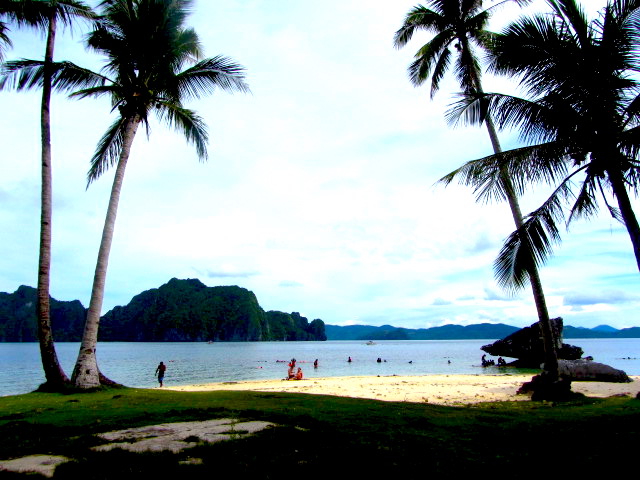
As we stretch our legs on the boat, we pass by hidden beaches with little cottages under palm trees.
We marvel at rocks in the water. Over and over again, we have to grin at each other because this can.not.be real. We go anchor in front of a wall of rocks, take the kayak and discover a secret lagoon through a little rift in the wall. All of a sudden it’s so calm. An oasis of quiet and peace.
We go snorkeling, which is quite something for someone who’s shy of water. The view below the surface is quite different – colorful corals, fish swarms, even turtles. Sometimes it’s worth to look deeper.
NOVATEK CAMERA
NOVATEK CAMERA
NOVATEK CAMERA
We have lunch at Entalula Island, a small beach with crystal clear water. The buffet looks like a feast with grilled fish, vegetables and fresh fruits. Afterwards we lie down on the boat and let the sun kiss our bodies. Yes, life is good.
We kayak into Cathedral Cove, a large opening in a rock. Inside it’s dark and we can hear bats flying high above us.
Our last stop on this perfect day is a small beach with palm trees and warm water where we take a few minutes to relax. When we get back to the boat, our friend steps into something. At first, he thinks it was a sharp coral, but by the time we get back to the harbor, his right foot has swollen to double its normal size and he can’t walk more than a few steps. The doctor says it’s nothing serious and that he should ake it slow for a few weeks, but on google we find a few horror stories about starfish and other dangerous creatures of the sea. “That’s some serious shit”, the diving instructor says when we tell him the story.
This has truly been a once in a lifetime experience.
The next morning we leave El Nido with a swollen foot, but with extremly full and grateful hearts.
This is part 3 of the series. Here or here are more stories!
This space has been empty a few Fridays in a row. I opened Kate’s page early on Friday mornings to check what the prompt was as I usually do. Then I would mull over a few thoughts and start typing.
Not in the last few weeks.
I was just blank. Even after a few hours of thinking and pondering, nothing would come to mind. Nothing. I felt like I had nothing to say. So I left this space blank. Week after week passed, Friday after Friday I grew more frustrated and angrier at myself. Has inspiration deserted me?
Where has all my creativity wandered off to?
If I compare my soul to a garden, there are different kinds of flowers and plants. Together they make a beautiful diverse image of creation, but each of them needs different care and nurturing.
Inspiration is a very delicate plant in this soul garden. It is planted deep inside everyone of us, but it will only grow depending how we take care of it. It’s so easy for inspiration to be suffocated with the thistles of busyness – a dangerous plant that grows like crazy if we don’t pay attention. It will drain the soil and leave us empty inside. I have been so busy lately with finishing off the school year while launching a book that I was too busy to pay much attention. Busyness had tied me up and I never really had time to stop and rest.
It can be hard to find inspiration in the midst of busyness. That’s why it is imperative to train our eyes to look for it, no matter how many thistles grow in our garden. I have lost the focus on beauty in the mundane a bit in the last few weeks.
And slowly by slowly, sentiments like frustration and anger have settled in my heart. I snapped at students, I got frustrated with colleagues, I didn’t see the good in others anymore. The bright and colorful garden had turned grey for me because I looked at it through the wrong filter.
Beauty is already here, right here and now. And I need it more than I can imagine. Only when I am able to admire the wonders around me, only when I allow God to speak to me, I am able to draw from that inspiration deep inside of me and truly create.
While I work in the garden I often get distracted by that voice inside of me.
You’re not good enough.
No one is going to read your words anyway.
Your work has to be perfect.
Far too often I give in to that voice. It’s like someone is slamming on my inner breaks and my hands are tied, I just.can’t.write. Instead of tending to the musings of my soul and responding to the inspiration inside of me, I worry about formats and what others will say about it. I fall for false expectations and am left empty in the end.
Can anyone relate? What can you find in the garden of your soul?
With summer approaching I want to take better care of my garden and all the different plants in it.
I want to be intentional about resting more.
I want to listen more before I do.
I want to look out for beauty all around me.
I want to protect my inspiration from lies and distractions.
I want to create again.
Our ferry leaves at 8:15 a.m. Destination: Tagbilaran on the neighboring island Bohol. There’s not much to do on the boat except watch some pirated Chinese movie (with Chinese subtitles) or sleep, which I desperately need. Jetlag has kept me awake for most of last night.
When we step off the boat two hours later, we’re greeted by a hoard of taxi drivers offering their services: “Where you going? Come with me, I give you best price!” We choose Martin who doesn’t speak much English except “Chocolate Hills” – the famous attraction on this island. Once we hit the road, we communicate with hands and feet that we’d like to make two more stops and miraculously, we end up at the right places.
Our first stop is a national sanctuary for Tarpiers, small primates which look a little like monkeys. We carefully walk through the tropical forest of banana palms to spot the tiny animals. “Do you see any?” – “Yes, look out for their huge eyes.” The bodies are incredibly small in proportion to their eyes. Interesting creatures.
We get back into the car and shortly after, we stop at what would be a real challenge for me. Across the Luboc River are two bridges made of banana leaves and a little bit of iron reinforcement. The only way across the river is across these bridges.
My knees begin to shake a little and I get nervous.
I’m afraid of heights, especially if there’s only water below me and very shaky ground underneath my feet.
Nevertheless, I step onto the bridge and slowly make it across the river. And I’m glad I did because the view and the sense of accomplishment are worth it.
For lunch we find a local shop that displays pots filled with meat and cooked vegetables. And rice, there’s always rice. Filipino food mostly consists of meat and isn’t really spicy, but I must admit I really lusted for some fresh vegetables after a while.
When we walk past a stand with baked banana, I just can’t resist. As the soft consistency and sweet taste fill my mouth I am suddenly taken back to long bus rides from Uganda to Tanzania or Rwanda, where we visited friends a long time ago. Five white people alone somewhere in the jungle.
Dozens of people shouting, “Mzungu, Mzungu (white person)” – oh, sweet sweet memories.
After lunch we walk around the streets and find the public market, a crowded place in the middle of town. Stalls offer everything – from fresh fruits to smelly fish to clothes to toys – and we buy some coconut juice. The lady picks two large nuts and slices the top part off, plucks a straw through the soft skin and hands it to us. Fresh juice, you just can’t get it any better than that.
We walk into one of the side streets and suddenly, the scene changes.
Colorful stalls become damp, dark shops.
Brick market buildings are replaced by rusty, instable shacks.
People sit in front of their tiny houses in dirty, torn clothes, kids are running around, often naked.
Wives cheer for their husbands as they play a board game and their wide-open mouths reveal several missing teeth.
As we walk through this chaos, people look up and stare at us. All of a sudden, I feel very uncomfortable in my own skin. Not because of them – because of me. I feel like I’m intruding into their streets, their lives, their world. My mere outer appearance doesn’t fit and I can do nothing to change that. No matter how hard I try to be different, I’ll never be the same. I don’t belong here and that is a rather strange experience. We turn around and make our way back to the main road.
Tricycles – the cheapest way to get around locally in the Filipino. Definitely a ride to remember!
On we go with our taxis to our final destination, Carmen. The roads are winding up and down the hill, but Martin still takes them at 120km/h. Whenever a tricycle or pedestrian seems to slow him down, he honks and they hurry to get out of his way. This is the Filipino way of driving: drive fast or make way. I’m surprised that I’m not carsick yet, but I find myself reaching for the door handle a few times.
When we arrive in Carmen, Martin is surprised to hear that we’re not staying at the pricy hotel direct next to the Chocolate Hills and it takes him a while to find the Bed&Breakfast tucked away in a rubble street. “You must be Katharina”, a woman greets me at the door.
This warm welcome is the beginning of a unique Filipino experience.
For the last four years, Grace has been running the B&B together with her Canadian husband Steve, who had just returned from a work assignment in Saudi-Arabia the night of our arrival. In his honor, the family – who all live on the property – prepare a feast for him and invite us along. Together with an elderly American missionary couple we get to taste Lechon – fire roasted piglet stuffed with vegetables. Interestingly, it is the same piglet we had seen running around early that afternoon…
Sharing a meal with our hosts is very special. We aren’t just guests in their home – we are invited to their table and share a bit of their lives. So we sit together, taste Filipino rum and ask questions about each other’s lives. They tell us how much Filipinos love Karaoke, they sing along whenever they know (or don’t know) a song on the radio. Their favorites are – of course – soft pop ballads.
The next morning we get up at 5 a.m. and ask a tricycle driver to take us to the Chocolate Hills. Tricycles are another great Filipino invention: buy a motorcycle and attach an iron cabin to it. It’s not really fast, but the easiest and cheapest way to get around locally. With three passengers, the tricycle driver struggles quite a bit to get us all the way up there, but we make it and are rewarded with a spectacular view: more than one hundred hills lie in front of us, their tops still hidden in the fog slowly rising up from the ground. A legend says the hills resemble giant tears shed for a lost love and they received their name from looking chocolate-brown during dry season. There’s no one on the platform except the three of us and we just take in the peaceful atmosphere of the morning. And finally, for once, the temperature is somewhat comfortable.
After a good breakfast at Grace&Steve’s, we say goodbye and head back to the ferry. In just two days we have seen and learned a lot. The only regret we have is that we couldn’t stay longer to experience more of Filipino hospitality.
This is part 2 of the series. Read more stories here, there or over here.
My blog has the ambiguous subtitle: thoughts of a traveling mind.
My mind often wanders off into strange thoughts and dreams or just ideas about the world. Some of these ideas you can read on this blog. But sometimes I actually get to travel, and there is so much new input that I can’t make sense of it just yet. So I write. And sometimes, on some days, I allow others to read along.
Today is one of those days.
Four flights, twenty hours on nine different buses and two boat rides in fourteen days.
A sensual overload in smell, taste and emotions.
A lot of pictures and the inability to put into words what I have seen – these were the Philippines.
After three days, I sit down with my notebook and a pen. I have to, I just have to write. I need to process all of this somehow.
These shoes have gone through mud and rain.
They have taken me to foreign terrain and new experiences.
They invite you to come along.
So tie your laces and let’s begin, shall we?
Episode 1. Cebu.
Busy.
I guess that’s the word you’d most likely use to describe Cebu City.
We land around four in the afternoon and get a cab into the city. The streets are crowded with many vans and Jeepneys – remnants of US colonial history now used as taxis, which can take about 15 passengers. They stop whenever you tell them to, so traffic is a constant stop and go. In between there are hundreds of motorbikes, the preferred method of transport for the Filipinos. Technically, there are lanes, but everyone just goes back and forth wherever traffic seems to be moving along. The outside temperature is around 35°C with 70% humidity and I’m glad our cab has got air conditioning.
The colorful and honking Jeepneys are omnipresent in Filipino cities
After we have reached our hotel in uptown, we explore the streets to find some dinner and end up at a really nice restaurant with a garden terrace. To the background music of soft pop ballads we order green mango juice and seafood – the perfect start to an extraordinary vacation. With seven hours of time difference, jetlag hits us quickly and we drift off into sleep very soon.
first meal: mussles and green mango juice
The next day we walk downtown to explore historical Cebu. The Philippines have been a Spanish, then an American colony and you can see traces of both if you take the time to find them. This proves to be more difficult than expected and a casual stroll through the city center resembles more a fight against masses of people on the streets, crazy traffic and a thick cloud of smog.
Electricity in the Philippines – overground and very (ahem) orderly…
The constant honking and the yells of people, combined with an excruciating heat, are nearly unbearable. I can feel sweat running from every pore of my body and my nose picks up the smell of burning trash and urine. We walk by men sitting in front of their shops, gawking at us who don’t fit in here at all. Past naked children playing in the dirt with toys made from trash. I had heard of the country’s poverty – now I see it and it breaks my heart.
Provisional huts made of iron sheets, the rivers become dumpsters, the streets living rooms for the poorDue to the bad, or rather non-existant, sewage system, you’re not allowed to throw anything down the toilet.
In the midst of traffic and crowds of people we find the Cathedral St. Nino and head inside. The Filipinos are mostly Catholic and you can find golden ornaments and figurines of saints everywhere. Since they have fans, we sit down and watch the service taking place at the moment.
People kneel or stand.
They kiss the Jesus figurine.
They seem very devoted. God is all around the globe, in all his different facets.
When we move on, we cross the Plaza Independencia and reach Fort de San Pedro, a former military base right at the waterfront. Its old stonewalls tell the stories of Portuguese conquest, Filipino tribal chiefs, friendship and war, strength and defeat. As we walk along one of the balconies, I feel a raindrop on my cheek.
This drop quickly turns into a midday downpour. This is quite typical in tropical countries during rain season and it’s a welcome relief for us sweaty and exhausted travelers. We sit down on a bench and watch the skies open, pouring down heavy, warm rain drops.
For about an hour, the noise of the city is drowned in the sounds of nature.
We pause, we slow down, we reflect.
At night we stop at a supermarket to buy bottled water and some soap. From the loudspeakers they play an entire One Direction album. Soft pop really seems to be THE choice of music here. When I ask a Filipino later why that is he tells me, “We are just emotional and sentimental people.” Maybe we shouldn’t tell them then that the band doesn’t exist anymore…
This is part 1 of the series. Click here or here for more stories!
When I was in fourth grade, I wrote my first book.
Well, technically I rewrote the story of Anne of Green Gables, a quirky girl who ends up in a small town with rather pessimistic people. Through chronic optimism and joyful demeanor she manages to turn this town’s perspective around. Continue reading “How I landed a book deal”
On Wednesday I had visitors come over who wanted to stay the night.
I was looking forward to their visit, but I was also a little nervous.
My schedule was completely packed because I had been in and out of the city for the most part of the last two weeks. There were clothes lying around on the floor, unpacked bags on the chairs, piles of paper on the table. A fine layer of dust covered the surfaces. My apartment was a mess.
How could I invite people into this place? So I started cleaning on Tuesday night, frantically getting rid of the chaos and presenting the best version of me and my place.Continue reading “Inside the Mess”
Three years ago, my mom and I started a tradition.
One weekend per year, we do a ladies’ getaway. Two days of hiking, relaxing, stuffing ourselves with delicious food and talking through the night. Continue reading “Everyday Heroes”





![A Break in Paradise [Philippines #3]](https://thisiskatha.com/wp-content/uploads/2017/07/el-nido-11.jpg?w=640)





![An Unexpected Invitation [Philippines #2]](https://thisiskatha.com/wp-content/uploads/2017/07/img_8223.jpg?w=640)


![Four Short Flights and a Whole New World Later [Philippines #1]](https://thisiskatha.com/wp-content/uploads/2017/07/img_8067.jpg?w=640)


 thisiskatha.com