[#write31days] Day 15 “There’s No One Else”

Welcome to Day 15 of #write31days! 
For more information check out the series’ page
———————————–

It’s the middle of the month and you might say: “Okay, I’ve heard a lot about boundary problems, I know why they are so important. I get it. But why is it still so hard to set boundaries?”
Good question. So let’s have a look at some of the lies in our heads that keep us from setting good boundaries.

Lie #1: There’s No One Else
I like to observe people, especially when they’re in bigger groups. Without even being aware of it, we all fall into specific roles. There are special groups dynamics and scenarios that seem to happen again and again.

Good work ethic and honesty is good. Being there for friends when they’re lonely is good. But there is a point of too much. There’s a point when we fall into the “no one else” trap.

17aThe overly responsible
Imagine a pile of work waiting to be completed and taken away. Maybe even some uncomfortable task. We all stare at each other, hoping someone will break before us and do the job already. We see others walking away pretending not to care (or maybe not pretending at all) and find ourselves left with this pile of work in front of us.
What do we do?
If you’re the overly responsible you will be the one staying late and doing the job. You feel like you can’t let your boss down and somehow the work needs to be done. No one wants to come back on Monday and see that pile of work waiting. And since all the others went home already, you’re the lucky one. It will be just this one time…maybe you’ve said this a lot of times already.

You don’t even have to leave your own house to find these dynamics. Who is the one cleaning the kitchen at night while the others watch TV? Who picks up the vacumer on Saturday because the apartment looks just too messy? Everyone in the family wants to have clean rooms, washed clothes, or food on the table, but not every one really feels responsible for it.
And so you work, and work, and don’t stop because someone has to do it.

We often associate this position with mothers, and mostly it’s true. But it can also relate to everyone else, we take patterns we learn at home with us. Patterns and roles we take on at work, with friends, with ourselves. 

17cAnd don’t we all have these experiences with friends or family members? “We need to hang out, I haven’t seen you in ages.”
“I need to talk to you because I can’t talk to anyone else.”
“If you don’t hang out with me I am all by myself and feel lonely.”
I can’t deny that I love good conversations, heart-to-heart with friends. I like to be there for friends and catch up after a while. And yes, it does sometimes feel good to be the go-to person for someone. The talk-to person, the good confidante.
But this can easily become a burden when you allow someone to completely rely on you. Instead of taking responsibility for themselves, your friends (or family members) let you carry them.
So you carry and you struggle with someone else’s problems because they have no one else. Apparently. Our extreme responsibility will tie us to others instead of teaching them to be responsible themselves.

The overly self-confident 
Sometimes it is also ourselves keeping us from setting boundaries. We can’t let go of something because we think we’re the only ones good at it.

15a
“If I leave now everything will fall apart. All this hard work I did over the years will not continue because no one but me can really do the job.”

This might be true. We are all unique, we’ve all been given unique gifts and talents. We’re all called to serve God and others with them.

Some use their talents more, others less. Some seem to be allrounders and these people are great to have at work or at church. But it can also be really hard because talent can get into your head. “I’m good at something” can also lead to “I’m the best at something”. Once you start using the perfectionist measuring tape no one else can measure up. 
I have to admit that I’ve caught myself in these thoughts sometimes. Striving for excellence is a good virtue, judging others from your high horse of perfectionism is not. Not just because it’s not my position to judge, but because I lost sight of the origin. I don’t use my talent anymore to serve others, I draw attention, appreciation and maybe even self-worth from it. This won’t serve anyone but my ego. 
I can’t go on forever, there’s a time for everything. So when I leave someone else will take over. And yes, they will do it differently because they are different. Will they be better or worse than me? Not important, it will be different.

What is your attitude? Can you stop working even though there’s still a lot to do? Can you let go of something you’re really good at? 

[#write31days] Day 14 Biblical Boundaries

Welcome to Day 14 of #write31days! 
For more information check out the series’ page
———————————–

We have talked about boundaries found in nature and in ourselves, but there’s one more source to look for boundary foundations: the Bible speaks a lot about freedom and grace and love for each other – this does not exclude boundaries, however. It actually recommends them.

God and Boundaries
Something that many people really have a hard time wrapping their mind around is God as trinity: Father, Son, and Holy Spirit. They are one, and yet they are three. Each of them has unique characteristics and features. The Father as creator and provider. The Son as savior and friend. The Spirit as counselor and encourager. They are all one, and yet there are clear boundaries. Weird concept, I know, but it shows that boundaries are not unfamilar in the spiritual realm.

In fact, God himself has set boundaries in nature. We find it in the creation stories and verses such as these:

Do you not fear me? declares the Lord. Do you not tremble before me? I placed the sand as the boundary for the sea, a perpetual barrier that it cannot pass; though the waves toss, they cannot prevail; though they roar, they cannot pass over it. Jeremiah 5:22

He has inscribed a circle on the face of the waters at the boundary between light and darkness. Job 26:10

We need boundaries in nature, otherwise we would constantly live in darkness (and who wouldn’t want to have these breathtaking sunrises and sunsets!). The land we live on would be swamp and our houses would sit on very shaky ground.
Certain boundaries secure and enable a safe life.

14bWhenever God sets boundaries he has good intentions for this place. A set apart place is where inheritance falls and prospers.

Thus says the Lord God: “This is the boundary by which you shall divide the land for inheritance among the twelve tribes of Israel. Ezekiel 47:13

The lines have fallen for me in pleasant places; indeed, I have a beautiful inheritance. Psalm 16:6

We will only see inheritance prosper if we set good boundaries. Not to close others off, but to protect our treasures. The treasures God has given us as our inheritance.


Take Care
We often consider ‘inheritance’ a physical thing – a piece of land, money etc. But especially the New Testament uses ‘inheritance’ in a different context. We as believers are promised eternal life with Christ, and parts of it are available now. Life with Christ is a life of abundance, of peace, of joy.
Faith is a gift, new abundant life is a gift. But we still need to use all our awareness and effort to protect it. Take care of that new life that’s been planted inside you.

Keep your heart with all vigilance, for from it flow the springs of life. Proverbs 4:23

And the peace of God, which surpasses all understanding, will guard your hearts and your minds in Christ Jesus.
Philippians 4:7

Taking care of our hearts, guarding our minds is not just an option – the 14abible tells us it’s essential. Keeping the life – the abundance – alive in us will revive everything else; letting it flow out will eventually dry up our strength, our energy, our motivation, our joy, our sense of self.


Take (No) Responsibility
This might sound awfully selfish in some people’s ears – isn’t the main message of Christianity to love others?
Yes, we have been loved from the very beginning, through all our failures, and until the very end. Because of this love we’re called to love others, especially when it’s hard. How does that look like in practice?

Bear one another’s burdens, and so fulfill the law of Christ. Galatians 6:2

We can show love very practically by carrying each other. Being there for each other, listening to someone’s stories. Crying with the sad, celebrating with the happy. Lifting each other up in prayer when you’re too weak to pray.
We can help each other out, cooking dinner when someone’s busy working. Moving boxes all around town when you have to change houses. Driving cross-country because someone just needs a friend.
We can only make it all the way if we walk together. 

14cYet, only three verses later Paul says this:

For each will have to bear his own load. Galatians 6:5

Carrying each other doesn’t mean to simply drop off all our cares with someone else. I can’t just let go because someone else will do everything for me. I can’t take all the blame because a friend refuses to take responsibility for him/herself.
Growing up ultimately is about taking responsibility for yourself and forcing others to do the same. Finding the balance between persevering to the end and allowing others to help might be one of the hardest exercises in the course of life.

Take some time to re-read these pieces of scripture in their contexts. Thank God for setting boundaries in nature and in your life. Allow him to show you where you still need to take care and responsibility of yourself and less of others. 

[#write31days] Day 13 Physical Boundaries

Welcome to Day 13 of #write31days! 
For more information check out the series’ page
———————————–

Nature has not only defined boundaries around us, our bodies are created with boundaries as well. From every hair on our head to our skin to our organs – everything has its specific order and serves a specific purpose. One. purpose. Not anyone else’s.

Early Childhood Development
We mostly complain about a lack of or the wrong kinds of boundaries as adults, but boundary foundations are actually laid at a very early age. Researchers and psychologists have made interesting discoveries when looking at how the relationship between an infant and its mother develops.
The first stage is all about close bonding. Babies know their mother really well; her smell, the sound of her voice, the shape of her face. Whenever she moves away from them they start crying. They feel insecure and lost. Why? Because they have no sense of self yet, they believe that mommy and them is one person (emotional object constancy).

12a

It is essential for infants to experience this close bonding, the love and care of a mother. They learn to feel safe and rooted in a loving and caring environment, an unbeatable foundation for their soul and spirit. 

Within the first year of life a change happens; some parents are surprised and shocked by it, when their cute and cuddling baby suddenly rebels and wants to get away from this close bond. Once again, it is important for parents to realize how necessary this step is for a child’s development. Every child needs to gain more independence and autonomy. The only way to do that is to separate and individualize. Mommy and baby are no longer the same, they are actually two independent individuals.

You can’t have “me” until you first have a “not-me”.
Cloud&Townsend. Boundaries.

I find it particular that the journey to your self and who you ARE goes via who you AREN’T. Children who never took that step to separate and explore their individual identity will struggle with setting boundaries as adults. Parents who don’t release their children to a certain extent will have trouble with respecting other people’s boundaries.
12cSeparation and individualization leads to experimentation. Toddlers (and teenagers later on) are driven by energy to explore the world. They often believe: I can do anything! This is perfectly okay because it will allow them to take risks, not shy away from challenges, and ultimately grow. Even as adults we need to experience this feeling once in a while. Nevertheless, the counterpart is just as important. Some have to learn it the hard way: I can’t do everything! And this is okay, too because somewhere along the way we’ll hopefully find our place. We’ll learn to maximize our strengths and say YES to good challenges, but also to accept our weaknesses and say NO to overburdening ourselves with the wrong tasks.

Our Body’s Radar
I find it amazing how our body has been created with a natural sense of boundaries. Just look at your skin. It protects the underlying layers of skin and organs from damage. It serves as a boundary to dirt from the outside and exchange point for bodily fluids. It keeps the good inside and the bad outside. 
Without any kind of training we have a sense of space, how close someone else is allowed to get to us. Normally we are not aware of this unless someone violates our personal space. A stranger coming closer than one meter is intimidating. He enters a space he doesn’t belong. It feels like he’s getting hold of us – our body, our soul, our mind – without even touching us. A group of people can be overwhelming at times because our personal space is taken away from us. These instincts most times are no sign of claustrophobia, they are our natural boundaries and protect our body with all its different layers.

12b These natural boundaries are a gift and we should appreciate them, especially when we think how easily this gift can be taken away. Victims of abuse and rape often suffer from a loss of boundaries. Of course, there’s physical harm, but the emotional damage is even greater: someone has violated your personal space, has overstepped your boundaries without permission, has taken something away without every giving it back.

Our physical boundaries are a gift and we should learn to appreciate and use them well.

Think about your own development for a moment: Have you ever thought about who you ARE and who you AREN’T?
What is your personal space? How close are people allowed to come, what is too close for you?

[#write31days] Day 12 Natural Boundaries

Welcome to Day 12 of #write31days! 
For more information check out the series’ page
———————————–

In the last few days we have talked a lot about problems we could have in setting boundaries with our family, our friends, in church, or with ourselves. We may have taken a closer look at ourselves and found some dark spots, things to work on.
And maybe a question came to mind: If so many problems can occur, why do I need boundaries? What do boundaries look like? Before we get into more practical details, let’s first discover boundaries all around us.

Boundaries in Nature
If you just take a closer look at your surroundings you’ll find boundaries that are not man-made. We have flat landscapes, hills and mountains, rivers and oceans. Somehow rivers stay in their beds unless there are floods. We also can’t just flatten mountains, we have to climb them.
We have different seasons, snow to rain to sun to drought – each takes care of the soil in its own way, with each we associate different things. Snow has its own charms, but after a long winter we all appreciate the first warmth in spring. We do want a bit of everything.

Property Rights
Of course, nature did not remain in its perfect state; man has conquered and shaped it. Before there were big towns and formal courthouses, people already had a sense to claim property. 13a
They put up stones that marked the beginning and end of their land. With time this became a bit more techy and a lot more complicated, but overall it’s the same.

We’re all familiar with the red STOP signs at big intersections. Even though many don’t always pay attention to them 🙂 they help to keep order on the street. If we all crossed at the same time there would be way more accidents.

12b2And I guess we also all have seen the NO TRESPASSING signs. Property belongs to someone, they normally payed a lot of money for it or inherited it. You can go to the courthouse and find out who it belongs to.
13bThe reason for these signs are normally not to annoy others. A town or someone owning property wants to keep out strangers, and signs make it very clear who and what is allowed and who/what isn’t. They also define the object behind the fence. You can’t go any further than the gate because this is private property. You can’t cross the intersection whenever you want because you would hurt other drivers. Boundaries tell us who we are and who we aren’t.

Boundaries define us. They define what is me and what is not me. A boundary shows me where I end and someone else begins…
Cloud&Townsend. Boundaries

Moreover, though, these properties come with a lot of responsibility. Owning a house can be a lot of work because you can’t pass it on to anyone else. A mayor of a town has a lot to do, for sure. Boundaries help to set things and people apart, but they also always come with responsibility.

Keeping the Good In and the Bad Out
If we think about the word and concept of ‘boundaries’ we normally tend to attach a negative connotation to it. Boundaries close other people off, they keep others outside, they don’t allow anyone to come in.
Boundaries force me to push others away, box myself in, maybe even stay away from things, people, and places.
One of the most interesting things for me to learn on this boundaries journey was a new understanding of the concept ‘boundary’.
Yes, sometimes it means to say NO to people.
Yes, sometimes it means to stay away from things and places.
Yes, sometimes it means closing off.
Boundaries are created to keep out the bad things that destroy our souls and lives.

13cWe need to understand that boundaries are there to protect.
They tell us who we are, so we can enjoy and live in freedom. They give us a safe space to live and act.
They inspire us to take risks with people and life, and rise above ourselves.
But they also tell us who we aren’t, so we don’t outstretch ourselves.
They prevent us from burning out in exhaustion.
They enable us to maintain good treasures and don’t throw them away in vain.

Take a closer look at boundaries in nature today. Pay attention to stop signs or other signs saying something about personal property.
What are some of the good things you want to protect in your life?   

[#write31days] Day 11 Sabbath

Welcome to Day 11 of #write31days! 
For more information check out the series’ page
———————————–

Setting healthy boundaries also means taking care of yourself. This also includes taking time off, making time for the things you enjoy. Things that restore your soul.
Luckily, God has set an entire day aside just for us. A whole day with lots of time to spend with Him, refresh our spirits in His presence, relax and restore. Restoration looks different for everyone; it’s just important that you find something that gives you energy, joy, and peace.
One thing that restores me is cooking. During the week it’s mostly just quick and simple, but on Sabbath I actually take time to find a cool recipe (or tweek with an old one), invest time in the kitchen, and have people around me to enjoy it with. So the Sundays of October will be filled with recipes – and if you enjoy cooking, too you might want to cook along! And if not, just give it a try, you might actually like it!

10cStuffed Aubergine

Ingredients for four people
11atwo medium/large aubergines
150g parmesan cheese, shredded
250g shredded cheese
one pack of ricotta cheese (you can also use white yoghurt)
3-4 tomatoes (or canned tomatoes)
salt, pepper, a bit of garlic, oregano
olive oil 

Wash the aubergines and cut them into thin slices, put some salt on them
Spread some olive oil onto a baking pan
Put them in the oven at 160°C for about 12 minutes until they’re soft

11c

11d


Mix the ricotta cheese/yoghurt with the parmesan cheese, garlic, and spices
When the aubergines have cooled off a little, fill them with the mixture

Dice the tomatoes and season with salt, pepper, and oregano (or simply use the canned tomatoes)

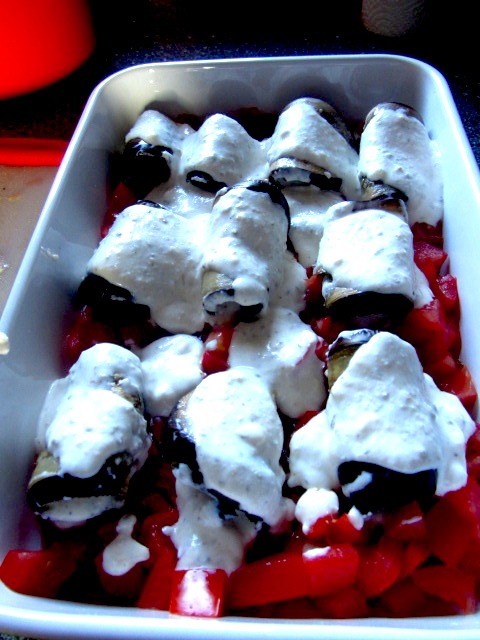
11eFill the baking pan with the tomato mixture

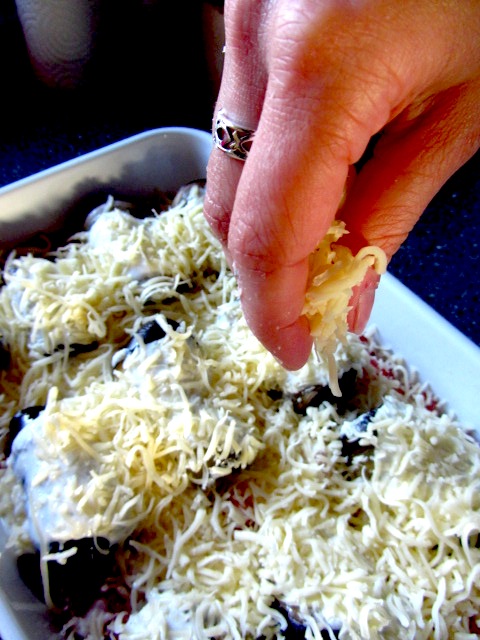
place the filled aubergines into the pan and cover it with the shredded cheese 11f

Bake in the oven at 160°C for another 12 minutes until cheese and stuffing is melted

Serve with baguette or potatoe wedges and a bottle of good wine

11g11h

[#write31days] Day 10 The Person in the Mirror

Welcome to Day 10 of #write31days! 
For more information check out the series’ page
———————————–

We all have our shares of fights in life.
We fight with our parents, our spouses, our children, our friends, our colleages. And we all know (or should know) how to solve these conflicts.
We can move out from home, we can break up relationships, we can stop talking to a friend, we can change jobs.
But the one person we can’t get away from is ourselves. As long as we live it is our challenge and responsibility to get to know ourselves, benefit from the strengths, and accept the weaknesses. This ‘getting to know yourself’ process can be hard and there are a few traps we can fall into.

10aThe Helper Syndrome

I have a friend who is sick. Whenever we meet up she only complains about her stressful life. Too little sleep, too little time for herself, too much work to do. When I ask her about her day or why she is so busy it always comes down to the same thing: she can’t get her own things done because she is too busy with other people. Some call this the ‘Helper Syndrome’. Of course we all appreciate a friend who helps us when we’re in need. Of course we want to be there for others and help out. That is perfectly okay. Sometimes. There is a fine line between being a friend and losing yourself, and people with the ‘Helper Syndrome’ tend to overstep it. They take care of other people’s business, tasks, emotions, even lives, so much that they can’t take care of themselves anymore.

The Crowdsurfer
People who don’t ‘suffer from the Helper Syndrome’ often appear to be super relaxed and easy-going. Unless they drift into the other extreme, I call them ‘crowdsurfers’. Instead of doing the work themselves they rely on others. Instead of taking care of themselves they cry for help. All. the. time. One obvious example might be a student in his mid-twenties who can’t cook a meal, doesn’t know how to clean the kitchen, and has to call his mom to wash his clothes. Yes, I have seen examples of this species in real life. Being an adult means separation from your home to a certain extent. Being grown-up means taking care of yourself, falling down sometimes with no one else to blame but yourself.

The Runner
Sometimes when I talk to my sister on the phone I complain about the many things I still have to do. And sometimes she says, “Come on, be honest. You love to have a good amount of stress in your life!”
She’s right.
Psychologists distinguish two kinds of stress, the good and the bad one. We need a certain level of motivation and adrenaline that keeps us going. Positive stress pushes us to grow and do good things, work builds our confidence. Negative stress, however, destroys our energy, our creativity, our self-worth. If we look at ourselves and the people around us, it becomes shockingly obviously that we give in to negative stress far too often. We are not inspired, we are just runners. We keep on going and working for all kinds of wrong reasons: more money, a promotion, the feeling of missing something important, the fear of losing our value when we reveal our weaknesses…

10bThe more we give in to negative stress the more we become deaf to our body’s needs.
Sleep? Overrated, I can do with four hours a night.
Food? Not too much, I don’t have time to eat and you get fat anyway.
Holidays? I wish…
We’re afraid to listen, really listen, and then take action. Let the work be work, enjoy a meal instead of gulping it down, ask others for help to get back on track. Often it doesn’t take much to make a big difference for our soul life. 

We can talk a lot to others about setting boundaries, taking things slow, or living intentionally. But before that we need to live it ourselves. Our body is our closest friend and our toughest enemy. Let’s take it serious.

Take an honest look at yourself: Are you a helper, a crowdsurfer, or a runner?
Do you have too much negative stress in your life? What could you change?

[#write31days] Day 9 Trust

Welcome to Day 9 of #write31days! 
For more information check out the series’ page
———————————–

It’s also Friday today, so I am linking up with my friends at Five Minute Friday.

I am afraid of heights. Climbing mountains is somewhat okay, the spectacular view from the top normally pays for the terror beforehand.
But as soon as I leave solid ground behind and all I have is a rope and an instructor yelling not-at-all-encouraging mantras after me, I panic. I don’t trust him that everything will be okay, that the rope will really hold me, that my strength will be enough, that the view is really worth it. So I stay on the ground and watch others climb.

Why do we have such a hard time setting boundaries?
This week we will talk a bit more about the lies that keep us from setting boundaries. But I think what it often comes down to is trust.
We don’t trust that the money we earn will ever be enough, so we continue to work even though we are completely exhausted.
We dont trust that our friends will still love us even if we are weak at the moment and have nothing to give, so we continue to pour from an empty heart until we’re completely dry.
We don’t trust that God is really good and has good intentions for our lives, so we continue to let worry eat away our soul and rather fix things ourselves than enjoying perfect peace.
We don’t trust ourselves, our strengths and talents, so we keep on chasing the wind and never get to experience the beauty of being in the right place.

Trust is not easy, it doesn’t happen in a day.
But the process starts with a little decision.
Every day.
It begins with an “I trust you” to the One who’s always trustworthy.
He’ll take you on a wonderful journey, trust me.

[#write31days] Day 8 Everything for the Kingdom

Welcome to Day 8 of #write31days! 
For more information check out the series’ page
———————————–

“We’re in need of a piano player for Sunday worship. Can you please help out?”
“You’re really good with devotions/children’s ministry/insert whatever ministry in here. We would love to have you fulltime for this.”

Are you familiar with these last-minute emails?
Just a small task. Just a little more giving. Because hey, it’s all for the kingdom of God and you certainly can’t hold back now.

I have been to quite a few churches and I always got more involved. For me, church is more than just going there on Sundays and enjoying a two-hour worship and sermon performance. It’s about the people serving together, sharing life together. The church is the living body of Christ, so we are so supposed to live and work together. 
But “serving and living together” can easily become a burden if we are not aware of its limitations and set appropriate boundaries.

Over-Serving
We all have been given certain gifts that we should use to serve God and others. A musical person who never plays an instrument is missing out on the blessings coming from music. An encourager who never opens his mouth will not see how his words uplift others. A teacher who never shares the word with others will never see that lightbulb going on in someone else’s head. The one who stays away will never experience the gift of community. 8a
Getting involved in various church ministries is a good way to connect with people. Giving will result in being given, I have experienced that. But sometimes we give too much. We invest in several places at the same time. Working with people especially can be tough because they don’t function like machines. They have their own thoughts, miss appointments, let you down.
Serving will drain energy. And if you give without ever receiving, you’ll burn out. Your talents are no longer used to bless others, they rather feel like being thrown away without anything in return.

Leave Your Brain Outside
In a normal church, after some worship and announcements comes the core element of the service: the sermon.
It is very easy to leave church feeling all good or moved or encouraged. Simply soaking up all the stories that remind you of better times.
It is very convenient to shut off your brain and just relax because the preacher won’t get to you anyway. Just take his words for granted, I mean he went to bible school, so he must know, right?
I am a digger (some also call me a nerd), I love to dive into things, explore different facets of words and concepts. So I always appreciate a preacher who doesn’t just touch my feelings, but gives me food for thought. I admire what others can grind out of a passage, how they inspire me even though I have read a text so many times before. But most of all, I enjoy preachers who make me want to go home and read my bible for myself. Who don’t spoonfeed me like a small child, but push me to question, to doubt, to learn. I benefit from other people’s wisdom and insight, but I am allowed, yes even challenged, to use my own brain and develop a personal relationship with God outside the church.

8b‘Church Work’
Not all of us are pastors, youth ministers, or worship leaders. Most of us have ‘normal’ jobs during the week and go to church on Sunday. Because we have these two different things going on we sometimes tend to separate our lives into two spheres: the worldly and the holy. These two can’t go together, so we have worldly and church friends, wordly and church personalities, wordly and church work.
For the last three years I’ve been part of a European Youth Movement inspiring and equipping young people to live a missional lifestyle. One major tool to do that is a bi-annual congress with more than 3000 people from all over Europe coming together to celebrate New Year’s, learning from God and each other, being inspired to serve. It is an immense blessing seeing and working with so many different people! But of course, organizing such a big event is a lot of work, a lot of ‘church work’. Tons of emails and requests, endless spreadsheets and logistics, many unexpected problems. All next to graduating from university and having a life. So what did I do? I wrote these emails and dealt with these problems on Sundays because it was ‘church work’. The day of rest was filled with work. Everything for the kingdom.
Well, to make it short, it worked for a while. But very soon I felt empty, burned out. I even got sick. My hands were in pain, I couldn’t type anymore, my back was sore. I gave everything, but could not go on.

8c
Jesus wants us to have abundance, to thrive, but His life will not break through if we bury it in work, no matter how holy and churchy it may be.


How do you spend your Sundays?
What kind of jobs do you have in your church? How do you feel about them?

[#write31days] Day 7 Friendships at a Junction

Welcome to Day 7 of #write31days! 
For more information check out the series’ page
———————————–

When we are a few years old it is time for us to leave the fold of the immediate family and expand our world. We enter kindergarten, then school, university, apprenticeships, work…
Along the way we meet many new people from all kinds of backgrounds with all kinds of lifestyles, likes and dislikes, and personalities. Some of them move on, sometimes we move on. Some of them leave a mark on our lives. Some of them we call friends.
Sometimes these friendships can be really tough. As if we were traveling on a road together, suddenly hitting a T-junction with a one-and-only decision: Where does our friendship go from here? 
I’ve had a few of these junction in my life lately, and they made me wonder about the different natures and kinds of friends. What are potential problems in friendships where we need to set boundaries?

7b

Please note: This is not a rant against personal friends or people in particular, it is rather trying to point out underlying principles by means of exaggeration (and a tiny bit of black humor).


The Phone that Never Stops Ringing
We all need friends, people who take an interest in us, share their lives with us, want to spend time with us. We all want to feel needed. 
But sometimes it can all become too much. 
When you feel exhausted and all you want is someone who listens to you, it can be a real challenge to have coffee with someone who talks about nothing else but themselves.
When you’re laden with questions and sorrows the least thing you can handle are friends dumping all their problems on you.
People taking it for granted that you’re always there to help. Grown-ups  expecting you to take care of them all the time.
May it be picking them up every weekend after a night of partying.
May it be solving relationship issues for them.
May it be you doing work for them because they don’t even ask if you’re free to do it. Isn’t that what friends do?
May it be always being available, no matter how late it is. You end up sleep-deprived because someone kept you up for something “really important”. You end up putting your life on hold because someone else has claimed your attention, your time, your soul.  

The point of friendship is to be there for each other, especially when it gets hard. This doesn’t involve taking over each other’s lives.

7aAll Alone out there
I’m a very giving person, I like to invest in people. Lots of my time is filled with writing emails, skyping or calling people all over the world. I like to connect because I like friends.
Last year this became really hard because my time was taken up with studying. I had moved too much, had to say goodbye way too often. It got really hard and tyring to keep in touch with everyone. Emails became rare, skype dates almost impossible to schedule.

There were days, sometimes even weeks without a word from friends. Nothing.
Days when the word ‘friend’ on Facebook sounds like a spit in your face.
That feeling of emptiness filling your soul.
Loneliness creeping up until it feels your room, your apartment, your heart.
The battle between bitterness, hatred, and sadness raging in your soul. 
The overwhelming fear that you’re all alone out there, that everyone has left you. 
Where are all the people I have invested in?
Do none of my ‘investments’ pay off?
Where are friends when you need them most?
Can I be on the receiving end for once when I’ve been giving for months and years?
Such lonely days can easily lead to a whole lot of questioning, desperation, fear, and anger. A downward spiral that can drag you down if you don’t fight against it.

Who are the people walking with you in life?
Do you rather give or take in friendships?
When does it become really hard for you to stay friends with others? 

[#write31days] Day 6 Work to Live – Live to Work?

Welcome to Day 6 of #write31days! 
For more information check out the series’ page
———————————–

Debates about work hours. Simply too much to do in too little time. Demonstrations for more pay. Always too little holidays. When most people think of work, they associate something negative with it.
Yet, even though we often complain about our work it is actually a good invention. Work was created for a good purpose.

I am not saying we should stop working all together or work 24-7. But maybe we should think a little bit about what work actually is and what makes it so ‘dangerous’ in our lives.
When you talk to older people who have been retired for a while, you can sometimes hear, “I miss it.” I’m sure they don’t mean the long working hours, the bad pay, or the rude boss. They miss the sense of getting up in the morning, having a destination to go to. The feeling of being needed somewhere. The satisfaction that comes from a day’ work with obvious results.
People who don’t do anything anymore are not at peace or completely rested. They feel lost. Without a purpose. At the verge of losing themselves.

What we do is a big part of who we are. We express our identity and personality through our movement, our emotions, our hands’ work.
But what we do should not define who we are. Otherwise you’ll lose yourself as soon as you stop doing what you’re doing.

In a world that revolves around busy schedules, timetables, meetings, and revenues, work seems to be the greatest virtue. A good worker is an eager, productive, and always-available worker.
How about that co-worker asking you for help on a project? You certainly can’t turn him down because you like your job and you don’t to disappoint your co-worker.
How about your boss asking you to stay longer because you’re simply the best for the job? Of course you’ll do it. Come on, it’s your boss and you can’t refuse. Being the best at something is quite the reputation you don’t want to risk losing. And trust me, it does feel good to be the go-to person, to see your name on pamphlets and invitations, to hear others talk about you with that certain ‘awe’.
We work because we want to please others. We don’t stop working because our reputation, our identity, our self is on the line. Our work is who we are. 
6a

In a world of linked devices, cloud accounts, and constant connection it’s almost impossible to escape work. You might leave the office, but you don’t leave work. There’s always something you can do from home, always an email you can answer from your smartphone on your way to something else. Work consumes our time, our thoughts, our hearts.
Yes, the thought of rest, the wish to just walk away from it all comes up once in a while, but is brushed away by fear of losing touch.

Articles on characteristics of Generation Y mention that while people are always on the move and have more choices than ever before, they are mostly driven by fear. Fear of losing, of missing out. The Guardian even called it an addiction: FOMA (fear of missing out). Whether it’s people’s attention and love, whether it’s better pay or a conference, or just a brilliant opportunity – we are driven by fear and insecurity. We don’t rest in who we are but try to compensate this void with work. Instead of finding ourselves we allow others to define who we are and what we’re supposed to do.

We can go on like this for a while without seeing any problems, we can work like crazy and chase our dreams. But the increasing numbers of burned-out workers, emotional breakdowns and people with no resilience indicate that this is not the life we’re supposed to live forever. If we don’t establish healthy boundaries when we’re young we won’t reap any fruits when we’re old.

Think about your work: How many hours per day are you busy for your job? How are the relationships to your boss and co-workers?
How often do you take off from work – switch off computer, phone etc.?